
EPR Packaging Compliance for Shopify: UK, Germany & France Guide
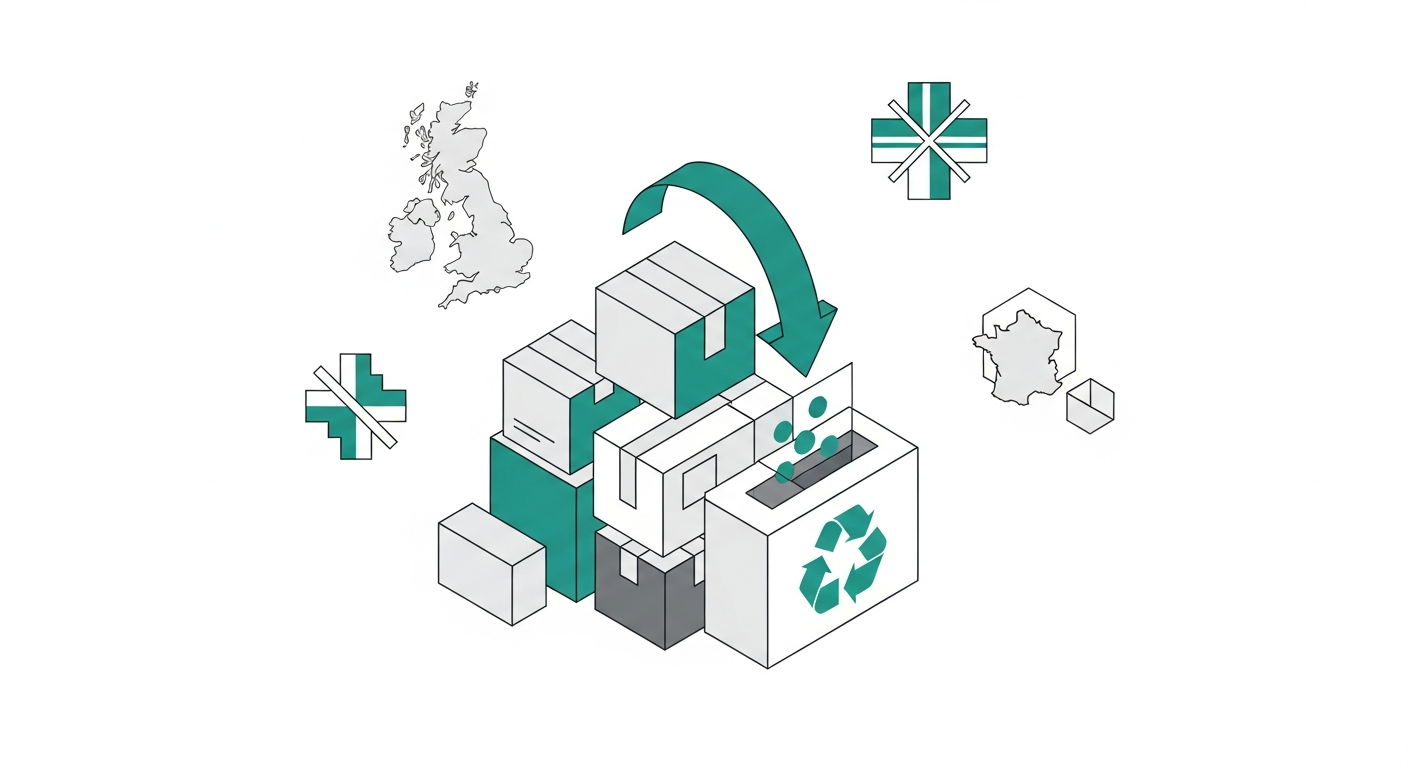
Your Shopify store just crossed €50k in sales to German customers. Congratulations. Now here's the part nobody mentions in the growth playbooks: you're officially on the hook for packaging waste in Germany. And France. And the UK if you're selling there too.
This isn't some distant regulatory threat — EPR (Extended Producer Responsibility) packaging laws are active right now, with real penalties for non-compliance. We've seen brands hit with €10,000+ fines because they didn't realize that shipping bubble mailers to Munich made them a "producer" under German law.
Here's the thing: every country does EPR differently. Germany wants you registered with LUCID. France has CITEO. The UK has its Plastic Packaging Tax. Same problem, three completely different bureaucratic solutions.
What is EPR Packaging Compliance for E-commerce?
Extended Producer Responsibility shifts the cost and responsibility of packaging waste from governments back to the companies that put packages into the market. If you're selling products online, you're the producer — even if you're dropshipping from a supplier in China.
The logic is straightforward: companies that profit from packaging should pay for its disposal and recycling. What's not straightforward is how each country interprets "producer," sets thresholds, and structures their programs.
Who Counts as a Producer?
Most e-commerce merchants assume they're safe because they don't manufacture packaging. Wrong. Under EPR packaging compliance Shopify merchants need to understand, you're typically considered a producer if you:
- Ship products to end consumers in packaging
- Import packaged goods and sell them domestically
- Private label products (even if manufactured elsewhere)
- Exceed country-specific sales or packaging quantity thresholds
The key word is "typically" — because Germany, France, and the UK each define this slightly differently. Let's get specific.
The Real Cost of Non-Compliance
Look, we're not trying to scare you. But the penalties are real. Germany can fine up to €200,000 for failure to register. France's CITEO can audit your records going back three years. The UK's Plastic Packaging Tax applies retroactively once you cross the 10-tonne threshold.
And here's what really stings: ignorance isn't a defense. "I didn't know" doesn't reduce penalties when you've been shipping to these markets for months.
UK Producer Responsibility (PPT) Requirements for Shopify
The UK has two separate packaging obligations that Shopify merchants need to track: general Producer Responsibility regulations and the Plastic Packaging Tax (PPT).
Producer Responsibility Registration
You need to register for UK Producer Responsibility if you handle more than 50 tonnes of packaging annually or have a turnover exceeding £2 million. This includes all packaging you supply — primary, secondary, and shipping materials.
Registration costs £1,164 per year (as of 2024), and you'll need to:
- Submit data by 7th May each year for the previous calendar year
- Pay recycling fees based on the tonnage and material types
- Keep detailed records of all packaging supplied
The recycling fees vary by material. Plastic costs around £580 per tonne, while cardboard is £99 per tonne. For a typical e-commerce business shipping 100 tonnes annually (roughly split between cardboard boxes and plastic mailers), you're looking at about £20,000 in annual fees.
Plastic Packaging Tax (PPT)
PPT is separate and more targeted. It applies to any business that manufactures or imports plastic packaging in the UK, once you exceed 10 tonnes annually. The tax is £210.82 per tonne for packaging with less than 30% recycled content.
Here's where Shopify merchants get caught: if you're importing products already packaged, you're considered the importer of that packaging. A small supplement brand we worked with discovered they'd unknowingly crossed the 10-tonne threshold importing plastic bottles. Their retroactive PPT bill was £4,800.
Registration Process
Both registrations go through the UK government's packaging data portal:
- Set up a Government Gateway account
- Register on the National Packaging Waste Database
- Submit your first data return within 28 days
- Set up quarterly data submissions
But here's the practical problem: tracking packaging tonnage across your entire Shopify catalog is tedious manual work. You need to know the weight of every box, envelope, and piece of void fill you use, then multiply by order volumes.
Germany LUCID Registration: Complete Setup Guide
Germany's packaging law (VerpackG) is probably the most complex EPR system you'll encounter. It requires dual registration: with the central LUCID register and with a licensed dual system operator.
LUCID Registration Requirements
Every company placing packaged goods on the German market must register with LUCID — regardless of size. There's no minimum threshold. Sell one product to a German customer? You need to register.
The registration itself is free, but you must provide:
- Company details and German tax number (or EU VAT number)
- Brand names under which you sell products
- Product categories and packaging types
- Annual packaging quantities (estimated for the first year)
And here's the crucial part: you must complete this before your first shipment to Germany. LUCID can block companies from selling if they discover unregistered producers.
Dual System Participation
Registration with LUCID isn't enough. You also need a contract with one of Germany's licensed dual system operators (like DSD, Interseroh, or Veolia). These companies organize the collection and recycling of packaging waste.
Pricing varies by operator and packaging type, but expect to pay around €0.80 per kg for plastic, €0.15 per kg for cardboard, and €2.50 per kg for glass. A mid-size Shopify store shipping 50,000 packages annually might pay €3,000-€5,000 per year.
Monthly Reporting Requirements
Unlike the UK's annual reporting, Germany requires monthly data submissions to both LUCID and your dual system operator. You must report:
- Packaging quantities by material type
- Any changes to registered brands or product categories
- Packaging that's been taken back or returned
Miss a monthly report? You'll get a warning first, then fines starting at €1,000. Miss three consecutive reports and your LUCID registration can be suspended.
Step-by-Step Setup Process
Look, we'll be honest: setting up German compliance manually is a pain. But here's the process:
- Obtain a German tax number through your local Finanzamt or use your EU VAT number
- Register at www.verpackungsregister.org (LUCID)
- Choose and contract with a dual system operator
- Calculate your annual packaging quantities by material
- Submit your initial data return within 30 days
- Set up monthly reporting schedules
The biggest stumbling block? Calculating packaging quantities. You need precise weights for every component — not just your product packaging, but shipping boxes, tape, labels, void fill, everything.
France CITEO Compliance: Registration and Reporting
France's EPR system runs through CITEO (formerly Eco-Emballages), and it's refreshingly straightforward compared to Germany's dual requirements. One registration, one annual report, one payment.
Registration Thresholds
You must register with CITEO if you're responsible for more than 50 tonnes of packaging annually in France, or if your annual turnover exceeds €1.2 million. Most Shopify stores hit the turnover threshold long before the tonnage one.
CITEO uses a points system based on turnover brackets:
- €1.2M - €5M turnover: 2 points (€1,340 annual fee)
- €5M - €10M turnover: 3 points (€2,010 annual fee)
- €10M+ turnover: Calculated based on actual tonnage
For higher turnovers, you'll pay based on actual packaging quantities — roughly €670 per tonne for household packaging.
The AGEC Law Impact
France's Anti-Waste Law (AGEC) added new requirements starting in 2023. If you sell certain product categories (textiles, electronics, furniture, toys), you need additional EPR registrations beyond packaging.
But for pure packaging compliance, CITEO remains your single point of contact. They handle collection, sorting, and recycling across France's territories.
Annual Reporting Process
CITEO requires one annual declaration, due by March 1st for the previous calendar year. You must report:
- Total packaging quantities by material (plastic, cardboard, metal, glass)
- Breakdown between household and non-household packaging
- Any packaging marked for reuse or return systems
Here's the practical challenge: most e-commerce businesses mix B2C and B2B sales. Packaging sent to consumers counts as "household" (subject to higher fees). Packaging sent to other businesses is "non-household" (lower fees). You need to track this split across your entire order history.
Registration Steps
CITEO registration is entirely online through their portal:
- Create an account at www.citeo.com
- Complete the company information form
- Declare your expected annual packaging tonnage
- Choose your payment schedule (annual or quarterly)
- Submit your first declaration within 30 days
The system generates automatic reminders for your annual declarations, which is helpful because the March 1st deadline is strict. Late submissions incur penalties starting at €1,500.
Automated EPR Compliance Management for Shopify Stores
Manually tracking packaging across three countries while running an e-commerce business is frankly unsustainable. When we were running our own brands, we'd spend entire weekends calculating tonnage reports instead of focusing on growth.
The math alone is complex. Your Shopify store might use 15 different box sizes, multiple mailer types, various void fills, and different label stocks. Multiply by order volumes, split by destination country, categorize by material type, then convert to the reporting formats each country requires.
What Automation Actually Solves
Good EPR compliance software should eliminate the manual calculation work entirely. It connects to your Shopify store, maps your packaging components, and automatically generates the reports each country needs.
The key features to look for:
- Direct Shopify integration that pulls order data automatically
- Packaging database with weights and materials for common supplies
- Country-specific reporting formats (LUCID XML files, CITEO declarations, UK data returns)
- Multi-currency fee calculations and payment tracking
- Compliance calendar with automatic deadline reminders
And here's what's crucial: the system needs to handle multi-country complexity. A single order to Germany might need reporting to LUCID, your dual system operator, and potentially trigger UK obligations if you're importing the products.
ROI of Compliance Automation
The time savings alone justify automation for most growing brands. A typical mid-size Shopify store spends about 20 hours monthly on manual EPR compliance across these three countries. That's 240 hours annually — roughly six weeks of work.
But the real value is avoiding penalties and audit failures. Germany's LUCID system runs automated checks against shipping data. If your reported quantities don't match your actual shipments, you'll get flagged for audit. Manual calculations are error-prone; automated systems maintain perfect consistency.
VeloxLink's Packaging Compliance tool, for example, integrates directly with Shopify to automate this entire process across UK, German, and French requirements. It handles the registration paperwork, generates country-specific reports, and tracks all payments and deadlines.
Implementation Strategy
Don't try to automate all three countries simultaneously. Start with your largest market, get the system working smoothly, then expand to the other territories.
The setup process typically involves:
- Cataloging all packaging components you currently use
- Mapping packaging to specific product categories or order types
- Configuring country-specific thresholds and reporting schedules
- Setting up automatic data exports to government portals
- Testing the system with historical data before going live
Most businesses see immediate benefits in month one — no more manual tonnage calculations, no missed deadlines, and much better visibility into actual compliance costs.
Compliance as a Growth Enabler
Here's the mindset shift: view EPR compliance as infrastructure for international expansion, not just a regulatory burden. Once you have automated systems handling UK, Germany, and France, adding new EU markets becomes much simpler.
Spain, Italy, and the Netherlands all have EPR packaging requirements. But they follow similar patterns — registration, reporting, and fee payment. The same packaging data that feeds your German LUCID reports can generate Italian CONAI declarations with minimal additional setup.
The brands that treat compliance as a competitive advantage are the ones scaling fastest into European markets. They're not spending weekends on packaging calculations; they're launching in new countries while their competitors are still figuring out their first CITEO registration.
Bottom line: EPR packaging compliance for Shopify stores isn't optional anymore in major EU markets. You can handle it manually and spend significant time on bureaucracy, or you can automate the process and focus on what actually grows your business. The math is pretty straightforward.